
A bookkeeper maintains your financial records. A controller oversees the accuracy and reliability of your accounting and reporting. A fractional CFO uses that information to help you plan, evaluate decisions, and manage the financial side of growth. The right support depends on what your business needs, and many businesses eventually need all three functions.
You can have your books up to date and still feel uncertain about your finances.
Maybe you receive a profit and loss statement every month, but nobody explains why margins are shrinking. Or you're preparing to hire, expand, or take on debt, and you're not sure how much the business can comfortably afford.
At that point, the question isn't necessarily whether you need a better bookkeeper. You may need a different level of financial support.
The terms bookkeeper, controller, and fractional CFO are often used together, but they don't describe the same work. Understanding the difference can help you avoid hiring for the wrong problem.
What Does a Bookkeeper Do?
A bookkeeper helps keep the day-to-day financial records organized and current.
Depending on the arrangement, bookkeeping work may include recording transactions, categorizing expenses, reconciling bank and credit card accounts, tracking invoices, and maintaining the information used to prepare financial reports.
This work matters because every financial decision depends on the quality of the underlying information. The IRS emphasizes consistent records and account reconciliation as part of sound business recordkeeping.
Consider a business that processes hundreds of transactions each month. If those transactions aren't recorded correctly, the owner may have an inaccurate picture of expenses or profitability. Before anyone can analyze trends or build a useful forecast, those records need attention.
Bookkeeping primarily answers: What happened financially, and has it been recorded correctly?
That doesn't mean a bookkeeper is responsible for deciding whether to open another location, change pricing, or hire a department manager. Those decisions require a different kind of analysis.
What Does a Controller Do?
A controller is responsible for overseeing the accounting function and making sure the financial information is reliable.
A controller's work may include reviewing the monthly close, overseeing reconciliations, maintaining accounting procedures, monitoring internal controls, managing reporting, and supervising accounting staff or outside providers.
The AICPA's controller role guidance distinguishes responsibility for accounting integrity and reporting from the broader enterprise-level strategy associated with a CFO.
Imagine a growing business with several employees involved in billing, payroll, expenses, and reporting. Transactions are getting entered, but the month-end close takes too long. Reports arrive late, and different people are using different processes.
That business may need someone to take ownership of how the accounting function operates, not simply someone to enter more transactions.
A controller primarily answers: Can we trust these financial reports, and do we have the right accounting processes in place?
Some controllers also participate in budgeting, forecasting, and operational planning. The exact responsibilities vary by company, but their core accountability is generally the quality and management of the accounting function.
What Does a Fractional CFO Do?
A fractional CFO provides senior-level financial leadership without requiring the business to hire a full-time CFO.
The focus is on using financial information to make decisions about the future. That may include cash flow forecasting, budgets, profitability analysis, growth planning, evaluating investments, and helping the owner understand the financial consequences of major decisions.
For example, say a business owner wants to hire two people because demand has increased. Revenue looks strong, but payroll is a recurring commitment. The owner needs to understand when the additional staff will become productive, what the hiring decision will do to cash flow, and how the business would handle a slower quarter.
A fractional CFO can help work through those questions using the company's actual financial position and reasonable assumptions about what comes next.
The Institute of Management Accountants describes the distinction between the controller's emphasis on accurate reporting and the CFO's emphasis on forward-looking financial planning and strategy.
A fractional CFO primarily answers: What do these numbers mean for the decisions we're making next?
A fractional CFO doesn't replace the need for accurate accounting. Forecasts built on unreliable financial information won't be especially useful, no matter how sophisticated they look.
Bookkeeper vs. Controller vs. Fractional CFO: Side-by-Side
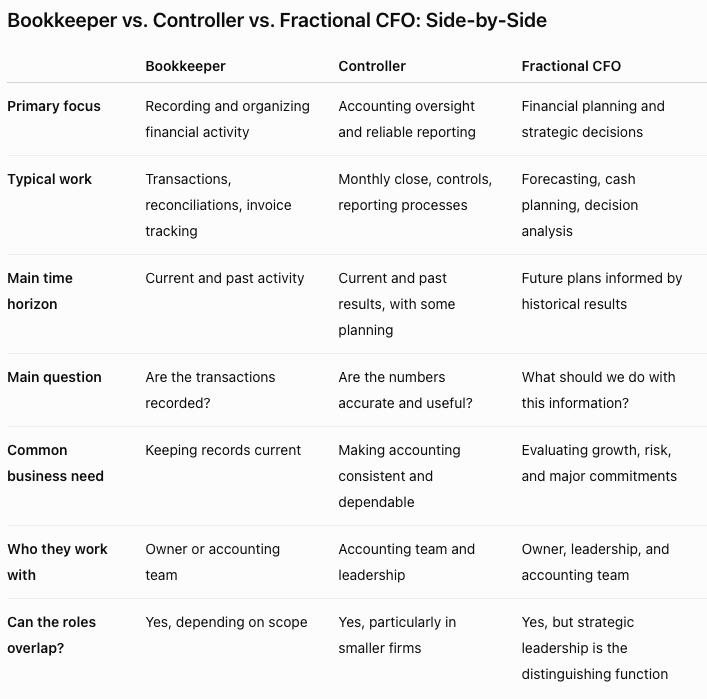
These aren't rigid job descriptions. A small business may have one professional covering several responsibilities, while a larger business may have separate people or teams for each.
Which Type of Financial Support Does Your Business Need?
The best starting point is the problem you're trying to solve.
Your financial records are consistently behind
If bank accounts aren't reconciled, transactions are missing, or you don't have dependable monthly records, start with the accounting foundation. Additional bookkeeping capacity or a better accounting process may be the immediate need.
Your books are maintained, but reporting is unreliable
Maybe reports are produced, but the close process is inconsistent, adjustments are frequent, or nobody is clearly accountable for the accounting team. That's a strong reason to consider controller-level oversight.
Your numbers are accurate, but decisions still feel uncertain
You know last month's profit. What you don't know is whether you can afford a new hire, how much cash a planned expansion will require, or what happens if sales fall short of expectations.
Those are fractional CFO questions. They require looking beyond what happened and evaluating what might happen under different decisions.
You're experiencing several of these problems at once
This is common as a business becomes more complex. You may need current records, stronger accounting oversight, and financial planning at the same time.
Hiring three separate people isn't the only option. An integrated accounting and advisory team can provide different levels of support according to the business's needs.
Why Hiring Only for the Most Obvious Problem Can Backfire
Business owners often notice the symptom before they identify the underlying issue.
If the reports are late, they might assume they need another bookkeeper. But if nobody owns the month-end close or checks the work, adding transaction-processing capacity may not fix the problem.
If cash is tight, they might assume they need a CFO. But if the accounting records are incomplete, the first priority may be cleaning up the financial information so cash flow can be assessed accurately.
And if the accounting is running smoothly but the owner is still making major decisions without forecasts or financial analysis, more bookkeeping won't address that gap either.
Before choosing a provider, ask three questions:
Can we trust our financial records?
Is someone accountable for the quality and timeliness of our reporting?
Do we have the financial analysis we need before making significant decisions?
Your answers will tell you more about the right next step than your annual revenue alone.
You May Not Need to Choose Just One
A business's financial needs don't always fit neatly into one job title.
At T&O Strategic Advisory, the goal is to connect the accounting foundation with the planning and advice business owners need as their companies grow. Depending on the situation, that can mean ongoing accounting support, stronger financial oversight, tax planning, or fractional CFO guidance.
The advantage of an integrated approach is that the people helping you make decisions are working from the same financial information as the people responsible for keeping it accurate.
That matters when a decision touches several areas of the business. Hiring affects payroll and cash flow. A change in business structure may have accounting and tax implications. Expansion can affect expenses, financing, and profitability long before the additional revenue arrives.
You want those conversations connected rather than handled separately after the fact.
How to Get Started
1. Identify your biggest financial frustration. Is it recordkeeping, reporting, or decision-making?
2. Review your most recent financial statements. Are they timely, accurate, and understandable enough to use?
3. List the decisions coming up in the next six to twelve months. Think about hiring, financing, pricing, expansion, and other commitments.
4. Match the support to the work. Look for a provider that can explain who will handle the accounting, who will review it, and who will help you make decisions based on it.
Get the Financial Support Your Business Actually Needs
You don't have to wait until your business is large enough for a full internal finance department to get reliable accounting and useful financial guidance.
T&O Strategic Advisory works with business owners who need help managing the financial side of their companies, from ongoing accounting and tax support to higher-level financial planning and advisory services.
If you're unsure what level of support makes sense, start a conversation with T&O Strategic Advisory. We can talk through what's working, what's missing, and where additional support would make the biggest difference.
Frequently Asked Questions
Is a bookkeeper the same as a controller?
No. A bookkeeper typically records and organizes financial transactions, while a controller oversees the accounting function, reporting quality, and internal processes. Responsibilities can overlap in smaller businesses, but the level of oversight is different.
What's the difference between a controller and a CFO?
A controller is generally accountable for accurate accounting and financial reporting. A CFO focuses more on financial planning, risk, funding, and strategic decisions. Both roles may participate in budgeting and analysis, but their primary responsibilities differ.
Can a fractional CFO replace a bookkeeper?
A fractional CFO doesn't eliminate the need for bookkeeping. The business still needs accurate records and dependable financial reporting. Some advisory firms can provide both functions through a coordinated team.
When should a small business hire a controller?
Consider controller-level support when the accounting process has become too complex to manage informally, reporting is inconsistent, or multiple people need oversight. The trigger is usually complexity and accountability, not a fixed revenue number.
When should a business hire a fractional CFO?
A fractional CFO may be helpful when the owner needs support with cash flow forecasting, growth decisions, profitability analysis, or financial planning. It's especially relevant when the accounting is reasonably reliable but the business needs more forward-looking guidance.
Can one accounting firm provide bookkeeping, controller, and fractional CFO support?
Yes. Some firms provide ongoing accounting, controller-level oversight, and strategic financial advisory within one team. The exact responsibilities and service scope should be discussed before engagement.