
A common starting point is to keep enough cash to cover three to six months of operating expenses, but the right reserve depends on your business. A company with predictable monthly collections may need a different cushion than one with seasonal sales, large payroll commitments, or customers who routinely pay late. Calculate your baseline expenses, then test the amount against your cash flow forecast.
A healthy bank balance can make it tempting to approve a new hire, buy equipment, or take a larger owner distribution. But that balance only tells you how much cash is in the account today. It doesn't tell you how much of that money will be needed next month.
For established businesses, the more useful question isn't simply, “How much cash should we save?” It's “How much cash do we need to keep the business operating when the timing of money coming in doesn't match the timing of money going out?”
That's what an operating cash reserve is for.
What is a business cash reserve?

A business cash reserve is money set aside to help cover operating needs when cash receipts fall short or unexpected costs arise. It is separate from cash you already expect to spend on regular bills, taxes, planned purchases, or distributions.
The FDIC's Money Smart for Small Business guidance describes a cash reserve as a fund businesses can draw on to meet business needs. Its examples include preparing for seasonal changes and setting aside a portion of profits over time.
A reserve can help a business keep making payroll while waiting on customer payments, absorb a temporary sales decline, or handle an urgent repair without immediately disrupting normal operations.
It is not the same as having extra money available for discretionary spending. A reserve has a specific job: protecting the company's ability to meet its obligations.
Is three to six months of expenses enough?

Three to six months is a useful reference point, not a universal rule. The FDIC's instructor guide notes that some businesses maintain reserves covering three to six months of operating expenses and recommends setting a goal suited to the business.
For one company, three months may provide meaningful protection. Another might need more than six months because its revenue arrives unevenly or because losing a single large client would significantly affect collections.
The right target depends on several practical questions:
How predictable is revenue? Recurring contracts and consistent payment histories generally make incoming cash easier to forecast than project-based or seasonal sales.
How quickly do customers pay? A company may book substantial revenue while waiting 30, 60, or more days for cash to arrive.
How much spending is fixed? Payroll, rent, insurance, debt service, and other commitments often continue even when sales slow.
How concentrated is revenue? If a small number of customers account for a large share of collections, a delayed or lost contract can have an outsized impact.
What is changing in the business? Hiring, expansion, equipment purchases, or a new service line can temporarily increase cash needs before additional revenue arrives.
A reserve target should account for these risks rather than relying on a single industry-wide number.
A useful cash reserve is based on what your business needs to keep operating, not on an arbitrary savings milestone.
How to calculate your business cash reserve

Start with the costs your business would still need to cover during a slower period. Then decide how many months of protection make sense for your revenue pattern and risk exposure.
Step 1: Identify essential monthly cash obligations. Review payroll, rent, insurance, software, required vendor payments, debt payments, and other recurring cash needs. Include obligations that might not appear as operating expenses on the income statement, such as loan principal payments. Keep planned tax payments visible in the forecast rather than treating those funds as available reserves.
Step 2: Calculate a realistic monthly baseline. Use actual payment history and adjust for known changes. Don't assume every cost disappears when revenue declines. Some expenses are variable, but others are difficult to reduce quickly.
Step 3: Multiply by your chosen coverage period. A basic formula is:
Essential monthly cash obligations × target months of coverage = preliminary reserve target
For example, imagine a business with $40,000 in essential monthly cash obligations:
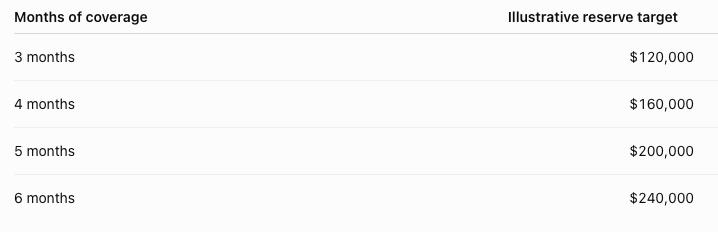
Illustrative calculation only; these are not T&O client figures or a recommendation for every business.
Step 4: Stress-test the target. Ask what happens if a major customer pays 45 days late, revenue drops for a quarter, or an unexpected expense arrives while payroll remains unchanged. A forecast can reveal whether the preliminary target is enough or whether your business needs a larger cushion.
This is where the calculation becomes more useful than a general rule of thumb. The reserve should cover the specific cash shortfalls your business could reasonably face, not just a theoretical number of months.
Why your reserve target may need to change as the business grows
A reserve that made sense two years ago may be too small today.
Consider a company that adds three employees and signs a larger office lease. Its monthly revenue may also increase, but the company now has more fixed expenses to cover regardless of when customers pay. The old reserve target was calculated for a different business.
Growth can also create temporary pressure on cash. A new employee may need to be paid for several months before their work generates enough additional collections to cover the cost. Inventory or equipment may require cash before related sales occur.
That's one reason cash reserve planning belongs alongside hiring plans, budgets, and forecasts. The SBA recommends using financial projections to understand future needs and incorporating cash flow statements and capital expenditure budgets into financial planning.
Review your reserve target when you make a major financial commitment, not only when the year ends.
Where should a business keep its cash reserve?

A reserve should be accessible when the business needs it. That usually means prioritizing liquidity and preservation of funds over chasing higher returns.
Some owners prefer a separate business savings account because it makes the reserve easier to distinguish from operating cash. Others track reserves through their cash management process. The best setup depends on the company's banking arrangements, expected access needs, and financial controls.
Make sure you understand account terms, withdrawal restrictions, and applicable deposit insurance limits. If balances are substantial, discuss appropriate account structures with your bank and financial advisor rather than assuming every dollar is protected in the same way.
A line of credit can be part of a broader contingency plan, but it is not a direct substitute for cash already available. Borrowing capacity may be limited, expensive, or unavailable when conditions change.
How to build a reserve without starving the business of cash

You don't need to fund the entire reserve in one transfer. A gradual approach may be more realistic, especially when the business already has significant commitments.
Start by identifying how much cash is consistently left after required payments and planned investments. Decide on a contribution amount that can be maintained without creating shortages elsewhere.
The FDIC's cash flow education materials suggest setting aside a percentage of profits, reviewing unnecessary spending, and preparing for seasonal changes. In practice, contributions should be based on available cash, not accounting profit alone.
If you operate a seasonal business, you may build reserves during stronger months and use them during slower periods. If collections are inconsistent, a fixed monthly transfer may be less suitable than contributions tied to actual cash receipts.
Also decide when the reserve can be used and how it will be replenished. Without that distinction, reserve funds can gradually become part of the normal spending account.
Use a cash flow forecast to check whether the reserve is adequate

A reserve calculation gives you a target. A cash flow forecast shows when you might need the money.
A forecast estimates expected receipts and payments over future weeks or months. It can highlight periods when the company has enough cash on paper but not enough available at the moment a major payment is due.
For example, a business may expect a large customer payment in the second week of next month. Payroll and a loan payment are due in the first week. Even if monthly receipts exceed monthly payments, the timing could create a temporary shortfall.
The FDIC's financial management guide distinguishes historical cash flow statements from forward-looking cash flow projections and explains why profitable businesses can still experience cash shortages.
Review your forecast alongside your reserve balance. If projected cash falls below the minimum level needed for operations, you may need to adjust spending, collections, timing, or your reserve target.
This is also where fractional CFO services can be useful. Rather than choosing a reserve amount once and forgetting about it, you can incorporate liquidity into ongoing decisions about hiring, expansion, and owner distributions.
When should you revisit your cash reserve target?

Revisit your target when the financial realities of your business change. Common triggers include adding employees, taking on debt, signing a long-term lease, losing a major customer, expanding into a new market, or experiencing longer collection times.
It's also reasonable to review reserves during routine financial reporting. Compare the current balance with your updated operating commitments and the cash flow forecast. If expenses have increased but reserves have stayed flat, your months of coverage may have quietly declined.
For owners who have outgrown managing these decisions alone, accounting services can support the accuracy of the numbers, while financial advisory support can help interpret what they mean for upcoming decisions.
Get a clearer picture of your business's cash needs

There isn't one reserve amount that works for every business. The goal is to know how much cash you need to meet commitments, what could cause a shortfall, and whether your current reserve would be enough.
T&O Strategic Advisory works with established business owners who need clearer financial reporting and more forward-looking guidance. If you're uncertain how much cash your business should keep available, talk with T&O about reviewing your cash flow and financial plans.
FAQ Schema: Small Business Cash Reserves
How many months of expenses should a small business keep in reserve?
Three to six months of operating expenses is a common starting point, but it's not a requirement or a universal target. A business with volatile revenue, large fixed commitments, or concentrated customers may need a larger cushion.
What counts as operating expenses when calculating a cash reserve?
Start with essential cash payments needed to keep the business operating, including payroll, rent, insurance, and necessary vendor costs. Also account for cash commitments such as debt principal payments, and separately plan for known tax obligations.
Is a business cash reserve the same as an emergency fund?
The terms are often used similarly. A business cash reserve may cover both unexpected expenses and predictable gaps between when bills are due and when customers pay.
Should I include taxes in my business cash reserve?
Money already earmarked for known tax payments should not be counted as freely available emergency cash. Forecast taxes separately so the reserve amount isn't overstated.
Can a profitable business still need a cash reserve?
Yes. Profit on an income statement does not guarantee that cash will be available when bills are due. Customer payment delays, loan payments, inventory purchases, and other timing differences can create cash shortages.
How often should I review my business cash reserve?
Review it as part of regular financial planning and whenever major obligations or revenue patterns change. A growing business may need to raise its reserve target as payroll and other fixed costs increase.