
To create a small business budget for 2027, review your historical financial performance, establish realistic revenue goals, estimate direct costs and operating expenses, and account for planned investments and cash commitments. Review your actual financial results against your budget each month to understand where adjustments may be necessary.
Before deciding how much revenue you want your business to generate next year, spend some time thinking about what you want that revenue to accomplish.
You might want to increase your compensation, hire another employee, pay down debt, or build enough cash reserves to feel more comfortable during slower months.
Each of those goals has a financial cost. Your budget should help you understand what your business needs to earn to support them.
What Is a Small Business Budget?
A small business budget is a financial plan that outlines how much revenue a business intends to generate, how much it expects to spend, and how much profit it aims to retain over a specific period.
A comprehensive business budget typically includes:
Revenue goals
Direct costs
Employee compensation
Operating expenses
Planned investments
Profitability targets
Cash requirements
Your budget provides a financial benchmark against which you can measure your actual performance throughout the year.
It also gives you an opportunity to evaluate whether your business goals are financially realistic before committing to them.
1. Start With Your 2026 Financial Results
Before creating your budget for 2027, review your financial performance over the past year.
Look beyond your annual revenue and profit totals. Reviewing your financial results by month can help you identify patterns that may influence next year's budget.
Pay particular attention to seasonal revenue fluctuations, changes in profit margins, recurring expenses, and significant one-time transactions.
For example, you may have purchased new equipment in 2026 that you won't need to replace next year. Alternatively, you may have hired an employee halfway through the year whose compensation will need to be included for all 12 months of 2027.
Neither of those situations would be accurately reflected by simply copying your current year's expenses into next year's budget.
Having accurate financial records makes it considerably easier to identify these differences and establish a realistic starting point.
2. Determine What You Want Your Business to Accomplish
Your financial goals should reflect what you're trying to accomplish as a business owner.
Before establishing a revenue target, consider what you want to change about your business over the next year.
Perhaps you want to increase your personal compensation without working additional hours. Maybe you want to expand your team, introduce another service, or reduce your reliance on debt.
You may also be perfectly comfortable with your current revenue and more interested in improving profitability.
These are all valid business goals, but they require different financial strategies.
If you want to reduce the amount of time you spend working directly with customers, for example, your budget may need to account for additional employee compensation or investments in operational efficiency.
Establishing those priorities before creating your budget can help you determine where your financial resources need to go.
3. Establish Realistic Revenue Goals
Increasing last year's revenue by 10% or 15% is a relatively easy way to establish a revenue target. But it doesn't necessarily tell you how your business is going to achieve that growth.
Instead, build your revenue budget around the activities that generate income.
For a service-based business, that might include:
Existing recurring client agreements
Anticipated new customers
Planned pricing adjustments
Additional services offered to existing customers
Expected customer departures
Available service delivery capacity
For a product-based business, you may need to consider anticipated sales volume, product pricing, seasonal demand, inventory availability, and distribution capacity.
Example of a revenue budget
Consider a hypothetical service-based business with 20 recurring clients paying an average of $2,000 per month.
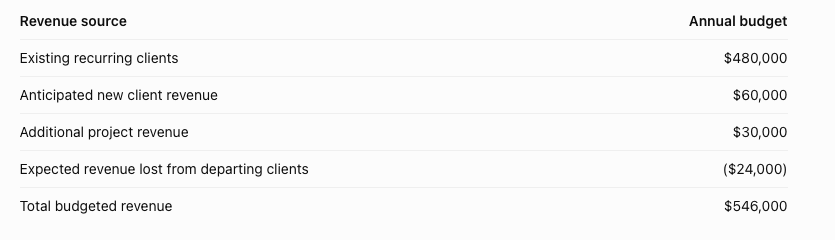
This approach gives the business owner a clearer understanding of what needs to happen to achieve the revenue target.
It also provides specific assumptions that can be evaluated throughout the year.
4. Calculate Your Direct Costs
Once you've established your revenue budget, consider what it will cost your business to deliver those products or services.
Direct costs may include materials, inventory, subcontractors, employee labor associated with service delivery, and other expenses directly related to generating revenue.
Understanding these costs is particularly important when you're planning to grow.
You might be able to serve additional customers using your existing team. Alternatively, increasing your revenue may require hiring additional employees or purchasing more inventory.
Those two scenarios will have very different effects on your profitability.
It's also worth reviewing whether your current pricing adequately reflects your delivery costs.
If the cost of providing a service has increased but your pricing hasn't changed, generating more revenue from that service may not improve your profitability as much as you expect.
Your budget should account for those changes rather than assuming that your historical profit margins will automatically continue.
5. Estimate Your Operating Expenses
Operating expenses are the costs associated with running your business beyond the direct costs of delivering your products or services.
These may include rent, administrative payroll, insurance, software subscriptions, marketing, professional services, utilities, and office expenses.
Start with your current recurring expenses and evaluate which costs are expected to change in 2027.
A vendor may have announced a price increase. You may be planning to increase your marketing budget or provide raises to your employees.
You may also discover expenses that no longer serve a meaningful purpose in your business.
When reviewing operating expenses, consider whether each expense needs to increase as your business grows.
Certain costs may remain relatively consistent even as revenue increases. Understanding where your business can accommodate growth without increasing expenses proportionately can help you establish more meaningful profitability goals.
The U.S. Small Business Administration's financial management resources provide additional information about managing business finances and evaluating financial performance.
6. Account for Hiring and Other Planned Investments
Significant financial commitments should be incorporated into your budget before you make them.
If you're planning to hire another employee, for example, consider the total cost of that position rather than just the employee's salary.
Payroll taxes, benefits, equipment, software, training, and onboarding can all affect the financial impact of hiring.
You'll also want to consider when those expenses will begin and when you expect the employee to contribute to additional revenue or operational improvements.
Our article on how to know if your business can afford to hire explores these considerations in more detail.
Other planned investments might include purchasing equipment, expanding your office, implementing new technology, or developing additional services.
Some investments may require substantial upfront cash without immediately affecting your profitability in the same way. Make sure your financial plan accounts for both the expense recognition and the timing of the cash payments.
7. Establish a Profitability Target
Once you've estimated your revenue, direct costs, and operating expenses, calculate your expected profit.
This is where you can begin evaluating whether your budget actually supports your financial goals.
Example of a small business operating budget
The following hypothetical budget illustrates how revenue and expenses can be used to establish an annual operating profit target.
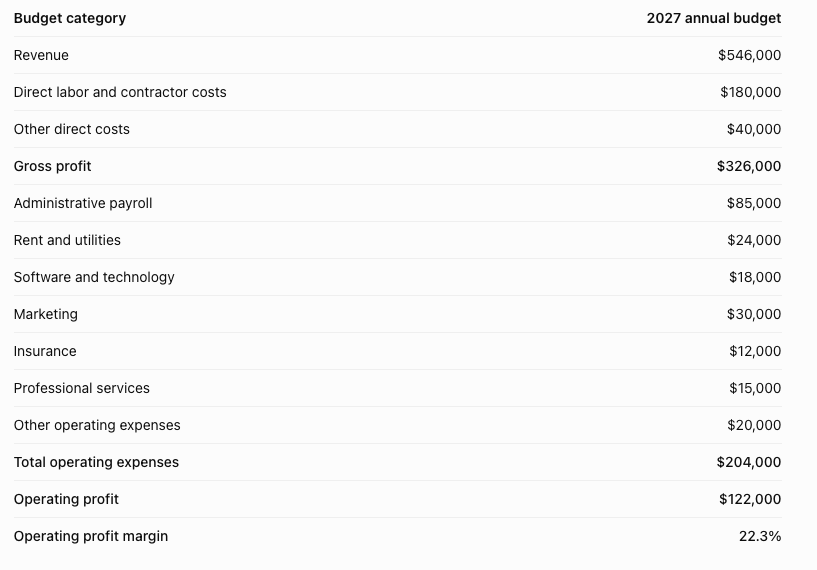
This budget projects approximately $122,000 in operating profit before interest and income taxes.
Whether that amount is sufficient depends on the business owner's goals, financial obligations, compensation structure, and plans for the future.
If the projected profit doesn't support those objectives, you have an opportunity to reconsider your pricing, expenses, revenue targets, or planned investments before the year begins.
8. Consider Cash Flow Separately From Profit
One of the limitations of an operating budget is that it doesn't necessarily tell you how much cash your business will have available at any particular time.
Your business may be profitable while still experiencing periods when cash is relatively tight.
Customer payment timing, loan principal repayments, equipment purchases, owner distributions, and tax payments can all affect your available cash.
Some of these transactions may not appear as expenses on your profit and loss statement.
For example, repaying the principal balance of a business loan reduces your available cash but isn't recorded as an operating expense.
That's why it's important to prepare a cash flow projection alongside your operating budget.
You should also consider how much cash you want your business to retain throughout the year and whether your planned spending will allow you to maintain those reserves.
9. Break Your Annual Budget Into Monthly Targets
An annual budget provides a useful overview, but it can be difficult to evaluate your progress if you don't know what your financial performance should look like throughout the year.
Dividing your annual revenue and expenses by 12 may work for certain predictable costs, but it doesn't necessarily reflect how your business operates.
If your revenue tends to be higher during certain months, your monthly budget should account for that seasonality.
The same applies to expenses.
Annual insurance premiums, software renewals, marketing campaigns, and planned hiring may occur at specific times rather than being distributed evenly throughout the year.
Establishing monthly targets allows you to compare your actual financial results with what you expected to happen during that particular period.
It can also help you identify months when your cash requirements may be higher than usual.
10. Review Your Budget Throughout the Year
Your budget shouldn't be something you create in December and revisit the following December.
Once your monthly accounting is complete, compare your actual financial results with your budget.
When you identify a significant difference, spend some time understanding what caused it.
If revenue is lower than expected, determine whether the difference is related to customer acquisition, pricing, delayed projects, or another factor.
If expenses are higher than anticipated, consider whether those additional costs were necessary and whether they're likely to continue.
Some differences may require immediate action. Others may simply reflect a change in timing.
Understanding the reason behind the difference is more useful than knowing the difference exists.
What's the Difference Between a Budget and a Financial Forecast?
A budget establishes what you intend to accomplish financially. A forecast estimates what you currently expect to happen based on the information available.
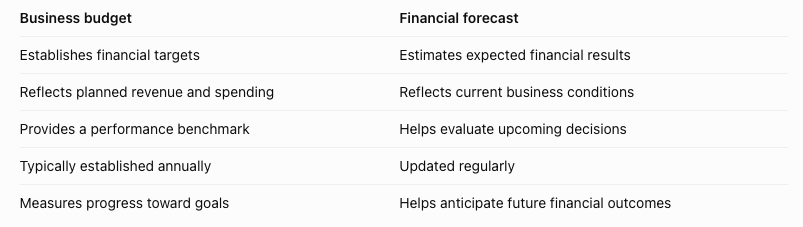
For example, you may establish a budget that includes acquiring five new customers during the first quarter.
By March, you may have acquired only two. Your original budget remains a useful benchmark, but your financial forecast should reflect the updated circumstances.
Using both tools allows you to evaluate your performance while making decisions based on what is actually happening in your business.
Common Small Business Budgeting Mistakes
A budget doesn't need to be particularly complicated to be useful. However, there are several mistakes that can make it less effective.
Overestimating revenue
Establishing ambitious goals is fine, but your budget should reflect a reasonable plan for achieving them. Avoid committing to significant expenses based entirely on revenue that hasn't materialized.
Underestimating the cost of growth
Additional customers may require more employee time, materials, technology, or administrative support. Account for those costs before assuming that revenue growth will improve profitability.
Forgetting irregular expenses
Annual subscriptions, insurance renewals, equipment replacements, and other occasional expenses can be easy to overlook when reviewing monthly financial statements.
Focusing exclusively on profit
A profitable budget doesn't guarantee that your business will have enough cash available to meet its financial obligations. Evaluate cash flow and profitability together.
Build a Budget That Supports the Business You Want
Creating a budget gives you an opportunity to think about the financial decisions you'll be making over the next year before you're in a position where those decisions become urgent.
It can also help you determine whether the goals you've established are realistic given your current financial position.
At T&O Strategic Advisory, Sarah and I help business owners develop financial plans that reflect what they're trying to accomplish, understand the financial implications of their decisions, and adjust those plans as their businesses evolve.
If you're preparing for 2027 and would like help developing a budget that supports your business and personal goals, we'd be happy to start the conversation.
Frequently Asked Questions
How do I create a budget for my small business?
Start by reviewing historical financial results, establishing revenue goals, estimating direct costs and operating expenses, and accounting for planned investments. Calculate your projected profit, evaluate your cash requirements, and establish monthly financial targets.
When should I create my 2027 business budget?
Ideally, small business owners should begin preparing their 2027 budgets during the fourth quarter of 2026. This provides time to review historical financial performance, evaluate upcoming commitments, and establish realistic financial goals before January.
What should be included in a small business budget?
A small business budget should include projected revenue, direct costs, payroll, operating expenses, planned investments, and profitability targets. A supporting cash flow projection should also account for payment timing, debt repayments, taxes, and other cash commitments.
How often should I review my business budget?
Review your business budget monthly after your financial statements have been prepared. Comparing actual results with budgeted amounts can help identify financial trends and areas that may require adjustments.
Can I create a business budget using a spreadsheet?
Yes. A spreadsheet can be an effective budgeting tool for many small businesses. Businesses with more complex operations may benefit from financial planning software or professional advisory support.
Can a fractional CFO help create a business budget?
A fractional CFO can help develop realistic revenue and expense assumptions, establish profitability targets, evaluate planned investments, and monitor financial performance throughout the year.