
A year-end financial checklist should include reviewing your financial statements, reconciling accounts, evaluating profitability, reviewing outstanding invoices, preparing for taxes, assessing cash reserves, and developing a financial plan for the upcoming year. Completing these tasks before year-end can help you identify financial concerns while there's still time to address them.
The last few weeks of the year tend to get busy. Between serving customers, managing employees, and preparing for the holidays, reviewing your business finances can easily get pushed into January.
The problem with waiting until January is that some of the financial decisions you could have made in December may no longer be available to you.
Even if you've had a successful year, it's worth setting aside time to understand where your business stands financially before heading into 2027.
1. Make Sure Your Accounting Is Up to Date
Before making any significant financial decisions, make sure you're working with accurate financial information.
If your accounting hasn't been updated in several months, your current financial statements may not reflect your actual profitability, outstanding obligations, or available cash.
Start by reviewing the following:
Bank and credit card reconciliations
Uncategorized transactions
Outstanding customer invoices
Unpaid vendor bills
Payroll records
Loan balances
Owner contributions and distributions
Pay particular attention to transactions that may have been recorded incorrectly or expenses that haven't been entered into your accounting system.
The IRS recordkeeping guidelines explain the importance of maintaining business records that support reported income and expenses.
Having accurate accounting records will also make it easier for your tax professional to prepare your business tax return and for you to evaluate your financial performance.
2. Review Your Profit and Loss Statement
Take a closer look at how your business performed throughout the year.
Rather than focusing exclusively on total revenue and net income, review your financial results by month or quarter. Compare those results with the previous year and your original budget, if you established one.
Consider whether:
Revenue increased or decreased.
Gross profit margins improved or declined.
Operating expenses changed significantly.
Certain services or products became more profitable.
Unexpected expenses affected your financial performance.
If your revenue increased substantially but your profit remained relatively unchanged, understanding why should be part of your financial planning for the upcoming year.
You may discover that your pricing hasn't kept up with your expenses, that certain services require more resources than anticipated, or that your business has accumulated additional overhead.
These are important things to understand before establishing new revenue goals or making additional financial commitments.
3. Review Your Balance Sheet
Business owners often spend considerably more time reviewing their profit and loss statements than their balance sheets.
Your balance sheet provides information about what your business owns, what it owes, and its equity at a particular point in time.
It can also help you identify financial concerns that aren't immediately apparent when reviewing profitability.
Pay particular attention to your cash balances, accounts receivable, inventory, outstanding debt, accounts payable, and equity balances.
For example, your business may have reported a strong profit this year while also accumulating additional debt or experiencing a significant increase in unpaid customer invoices.
Understanding those changes can give you a more complete picture of your financial position.
Reviewing your balance sheet before year-end also gives you an opportunity to identify discrepancies or outdated balances that need to be addressed before your accounting records are finalized.
4. Review Outstanding Customer Invoices and Vendor Bills
Money that customers owe your business isn't necessarily money you'll have available when you need it.
Review your accounts receivable aging report to identify invoices that are approaching their due dates or are already overdue.
If certain customers consistently pay late, consider whether changes to your invoicing processes, payment terms, or collection procedures might improve your cash flow next year.
You should also review your outstanding vendor bills and other upcoming financial obligations.
Between payroll, annual software renewals, insurance payments, and other expenses, the beginning of the year can involve considerable cash commitments.
Understanding what you expect to collect and what you'll need to pay can help you avoid unnecessary cash flow surprises in January.
5. Have a Conversation With Your Tax Professional
If you haven't already discussed your expected tax liability with your tax professional, now is the time to do it.
Waiting until your tax return is being prepared can limit your ability to make certain decisions that could affect the current tax year.
Depending on your business structure, accounting method, and individual circumstances, your tax professional may want to discuss:
Estimated taxable income
Estimated tax payments
Planned equipment purchases
Retirement plan contributions
Owner compensation
Potential deductions and credits
Upcoming filing and payment obligations
The IRS provides information about estimated taxes for businesses and self-employed individuals, including general payment requirements.
It's also important to consider the broader financial impact of any year-end tax planning decisions.
Purchasing equipment solely because it may provide a tax deduction doesn't necessarily make financial sense if your business doesn't need the equipment or cannot comfortably support the expense.
Your tax strategy should work alongside your overall financial strategy.
6. Evaluate Your Cash Reserves
Before heading into the new year, take some time to understand how much cash your business has available and what that cash needs to cover.
Your current bank balance may include money that will eventually be used for taxes, payroll, vendor payments, debt repayments, or other financial obligations.
Once you've accounted for those commitments, how much cash is actually available to support your business?
The appropriate amount of cash to keep in reserve will depend on several factors, including:
Your monthly operating expenses
The consistency of your revenue
How quickly customers pay
Seasonal fluctuations
Existing debt obligations
Upcoming investments or financial commitments
A business with predictable recurring revenue may have different cash reserve requirements than a business that relies on large, irregular projects.
Consider whether your current reserves would allow you to continue operating comfortably if revenue temporarily declined or an unexpected expense occurred.
If your business is entering the new year with limited cash reserves, building those reserves may deserve more attention than pursuing additional growth.
7. Review Your Business Expenses and Financial Commitments
Year-end is a good opportunity to review what your business is spending money on and whether those expenses continue to make sense.
Start with recurring expenses, particularly subscriptions, software, insurance, professional services, and other ongoing commitments.
You may be paying for tools your team no longer uses, services that overlap, or subscriptions that were originally purchased for a specific project.
You should also consider whether any significant expenses are expected to increase next year.
A vendor may have announced a price increase. Your insurance premiums may be changing. You may be planning to increase employee compensation.
Identifying those changes now allows you to incorporate them into your financial plan rather than discovering them after the expenses have already increased.
The goal isn't necessarily to reduce spending. It's to understand where your money is going and whether those expenses support what you're trying to accomplish with your business.
8. Evaluate Your Staffing Plans for the Upcoming Year
If you're considering hiring another employee in 2027, start evaluating the financial implications before the new year begins.
Consider the total cost of bringing someone onto your team, including compensation, payroll taxes, benefits, training, equipment, and software.
You'll also want to think about how long it may take for that employee to become fully productive and whether your existing revenue can support the additional expense during that period.
We've discussed these considerations in more detail in our article on how to know if your business can afford to hire.
If your current team is already struggling to keep up with demand, consider whether additional staffing is the best solution or whether improvements to your existing processes could help.
Understanding what your business needs operationally and what it can support financially should be part of the same conversation.
9. Establish a Budget and Financial Forecast for 2027
Your financial results from 2026 provide a useful starting point for planning the upcoming year.
But simply taking this year's revenue and expenses and increasing them by a predetermined percentage may not give you a particularly useful financial plan.
Start by considering what you actually expect to happen in your business.
Are you planning to increase your prices? Do you anticipate bringing on additional customers? Will you be introducing new services or making significant investments?
Your budget should reflect the financial goals you've established for your business, while your forecast should reflect what you realistically expect to happen.
The U.S. Small Business Administration's financial management resources provide additional guidance on managing business finances and understanding financial performance.
Once your budget and forecast are established, make time to review them throughout the year. As your circumstances change, your financial projections should change with them.
10. Revisit What You Want Your Business to Provide for You
Before establishing your financial goals for 2027, consider what you actually want to accomplish as a business owner.
Increasing revenue may be one of your goals, but it doesn't have to be your only goal.
You might want to increase your personal compensation, build stronger cash reserves, reduce debt, spend less time managing day-to-day operations, or create more flexibility in your schedule.
Each of those objectives has financial implications.
For example, if your goal is to spend less time working directly with customers, your financial plan may need to account for additional staffing or operational improvements.
If you're hoping to increase your personal compensation, improving profitability may be more important than increasing revenue.
Understanding what you want your business to provide for you can help you establish financial goals that are more meaningful than simply earning more next year.
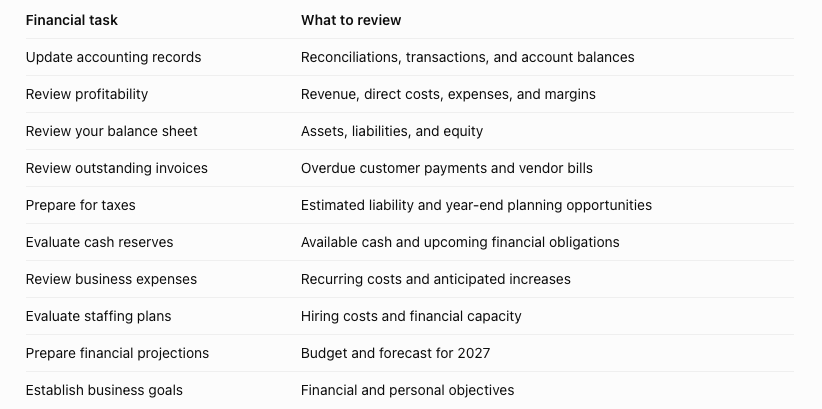
Small Business Year-End Financial Checklist
Use this checklist to organize your financial review before closing out the year.
Don't Wait Until January to Understand Your Financial Position
There will always be things that need to be finalized after the year ends. But you don't need to wait until your financial statements are completely finalized or your tax return has been prepared to start evaluating your business.
Having a better understanding of your financial position now can help you make more informed decisions during the remaining weeks of the year and enter January with a clearer plan.
At T&O Strategic Advisory, Anna and I help business owners understand their financial performance, prepare for upcoming financial commitments, and make decisions that support their longer-term goals.
If you haven't had an opportunity to take a closer look at your business finances this year, we'd be happy to start the conversation.
Frequently Asked Questions
What should a small business do financially before year-end?
Small business owners should update their accounting records, review financial statements, evaluate outstanding invoices and bills, discuss tax planning with their tax professional, assess cash reserves, and prepare financial projections for the upcoming year.
When should small businesses start year-end financial planning?
Ideally, businesses should begin reviewing their year-end financial position during the fourth quarter. Starting before December gives business owners more time to evaluate financial decisions and address potential concerns.
What financial statements should I review at year-end?
Business owners should review their profit and loss statement, balance sheet, and statement of cash flows, when available. Accounts receivable and accounts payable aging reports can provide additional insight into upcoming cash commitments.
Should I spend money before year-end to reduce my business taxes?
A purchase may provide a tax benefit if it qualifies under applicable tax rules, but the expense should also make financial and operational sense. Discuss potential purchases with your tax professional and evaluate their impact on your cash flow before making a decision.
Do I need both a budget and a financial forecast for the new year?
A budget establishes planned financial goals, while a forecast estimates expected financial performance based on current information. Using both can help business owners measure progress and adjust their financial decisions as circumstances change.
How can a fractional CFO help with year-end financial planning?
A fractional CFO can help business owners evaluate financial performance, assess cash flow, develop budgets and forecasts, and understand the financial implications of upcoming business decisions. They can also coordinate with other financial professionals to support broader financial planning.