
Your business can afford to hire an employee when it can cover the full ongoing cost of that position, maintain enough cash for existing obligations, and support the hire through a realistic ramp-up period. A profitable month or a healthy bank balance alone isn't enough. The decision needs to work in your cash flow forecast.
You have more work coming in than your current team can comfortably handle. Clients are waiting longer for responses, projects are taking more time, and you're spending your evenings doing work that someone else could take over.
Hiring seems like the obvious next step. But the financial question isn't simply whether you can pay the salary you're advertising.
It's whether the business can support another ongoing commitment, including the months before that person is fully productive.
Start with the full cost of the employee
An employee's salary is only one part of what the business pays. Depending on the role, location, and benefits you offer, you may also need to budget for employer payroll taxes, unemployment insurance, workers' compensation, health benefits, retirement contributions, recruiting, software, equipment, and training.
The Bureau of Labor Statistics reported that, across private industry in June 2026, wages and salaries represented 70% of average employer compensation costs, while benefits accounted for 30%. That is a national average across many kinds of employers, not a multiplier you should automatically apply to your own business.
For your hiring decision, calculate the actual expenses associated with the position.
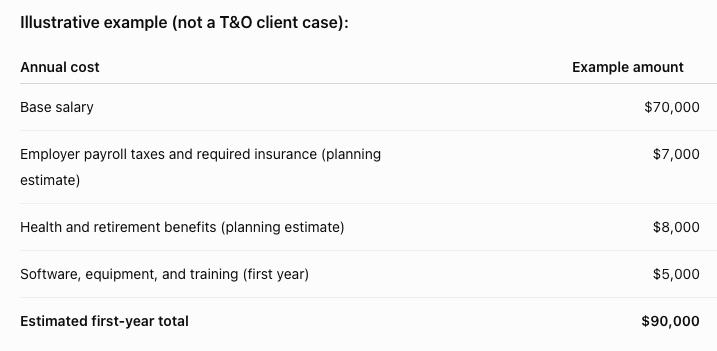
In this example, a $70,000 salary becomes a $90,000 first-year commitment. Actual employer costs vary by state, industry, coverage, and employment arrangement. The SBA's hiring guidance and IRS Employer's Tax Guide are useful starting points for identifying payroll obligations.
A business owner who budgets only for salary may be surprised by how much more cash goes out once the position is filled.
Look at what your cash flow can support, not just your profit
A profitable business can still struggle to meet payroll. Revenue might be recorded before customers pay. A large project may generate profit on paper while the cash arrives in installments. Meanwhile, rent, loan payments, taxes, and existing payroll are due on fixed dates.
A new hire adds another set of dates you cannot casually move around.
Review your cash flow forecast for at least the next several months. Include expected customer payments, existing operating expenses, taxes, debt obligations, and the proposed employee's full cost. Be conservative about money that hasn't been collected yet.
For a business with uneven sales or long customer payment terms, a longer forecast may be necessary.
The question to answer is straightforward: After paying everyone and everything already committed, can the business consistently make the additional payroll payments?
Account for the time it takes a new hire to become productive
Even a strong employee needs time to learn your systems, understand your clients, and get comfortable with the work.
During that period, the business is paying for the position without necessarily receiving its full expected benefit. Existing team members may also spend time training the new person instead of doing their usual work.
For a revenue-producing position, estimate how long it will take before the employee contributes enough additional gross profit to cover the role's cost. For an operations or administrative position, evaluate whether the hire will reduce bottlenecks, protect service quality, or free higher-value capacity. Those benefits are real, but they shouldn't be presented as guaranteed new revenue.
A hiring plan that only works if the new employee is immediately productive is too optimistic.
Test the decision against three possible outcomes
A single forecast can make a hiring decision look more certain than it really is. Instead, compare a few reasonable scenarios.
Expected case: Revenue and collections follow the plan, and the employee reaches normal productivity within your anticipated timeframe.
Slower case: Customer payments arrive later, onboarding takes longer, or demand is softer than expected.
Stronger case: Demand increases and the new hire allows the business to serve more customers without compromising delivery.
The slower case is especially useful. If a modest delay in revenue would force you to miss payroll, postpone taxes, or draw down cash needed for other obligations, the timing may not be right.
That doesn't automatically mean you shouldn't hire. It may mean the business needs to build reserves, adjust the role, phase in the expense, or improve collections first.
Make sure you're solving the right problem
Hiring is sometimes the right answer to a capacity problem. Other times, the business needs better processes, clearer responsibilities, improved pricing, or more consistent financial information.
Consider what is actually creating the pressure:
Too much work for the existing team: A hire may increase capacity if demand is durable.
Work is disorganized or frequently redone: Better processes may be more effective than adding another person.
The owner is handling every financial decision: Accounting and strategic financial support may free up time without creating a new full-time internal position.
Revenue is growing but margins are shrinking: Review pricing, direct costs, and productivity before adding overhead.
For owners who are making bigger staffing and investment decisions, reliable reporting and forward-looking advice become increasingly valuable. Before adding another employee, make sure you understand whether the problem is actually a staffing issue or whether better financial processes could help. Having accurate, up-to-date financial information can make it easier to evaluate what your business really needs.
A practical four-step hiring check
1. Calculate the full cost. List salary, employer taxes, benefits, recruiting, equipment, training, and other position-specific expenses. Separate one-time costs from ongoing monthly costs.
2. Build the forecast. Add the new expenses to a cash flow forecast that includes existing commitments and realistic payment timing.
3. Model the ramp-up. Estimate how long the role will take to contribute its intended value. Don't assume immediate results.
4. Test the downside. Reduce expected revenue or delay collections and see whether the business can still cover its obligations without exhausting its reserves.
If the hire passes those checks, you can move forward with a clearer understanding of what the business is committing to. If it doesn't, you have specific numbers to work on rather than a vague feeling that the timing is wrong.
Know what the decision will change six months from now
A hiring decision shouldn't be based only on today's workload. Think about what you expect the business to look like after the new employee has settled in.
Will the role let you take on more work? Will it reduce overtime or turnover risk? Will it give the owner time to focus on sales, leadership, or client relationships? What will you measure to know whether the position is working?
Set expectations before hiring. Otherwise, six months later, you may know payroll has increased without being able to explain whether the investment accomplished what you intended.
A useful financial review connects the cost of the position to the operating changes you expect it to produce. This is the kind of forward-looking decision that can benefit from hiring a fractional CFO.
Make the hiring decision with the numbers in front of you
You shouldn't need to guess whether another employee fits your budget. The right forecast can show what the position will cost, how the timing affects cash, and what needs to happen for the hire to make sense.
T&O Strategic Advisory helps business owners build stronger financial visibility and evaluate decisions like hiring with a clearer view of their numbers. If you're considering expanding your team, contact T&O Strategic Advisory to discuss the financial side of the decision.
Frequently Asked Questions
How much money should a business have before hiring an employee?
There isn't one dollar amount that works for every business. Estimate the full cost of the hire, forecast when the payments will be due, and determine whether you can cover them while meeting existing obligations and maintaining an appropriate cash reserve.
How do I calculate the true cost of hiring an employee?
Start with salary or hourly wages, then add employer payroll taxes, required insurance, benefits, recruiting, equipment, software, and training. Some costs are recurring and others occur only when the employee starts, so budget for both.
Should I hire if my business is profitable?
Profitability is useful, but it doesn't prove the business has enough cash available for another payroll commitment. Review cash flow, payment timing, existing obligations, and the employee's expected ramp-up period before deciding.
How far ahead should I forecast before hiring?
Several months is a practical starting point, but businesses with seasonal demand, long payment cycles, or large fixed obligations may need a longer view. The forecast should cover the period when the new employee is not yet fully productive.
What if I need help but can't afford a full-time employee?
First identify the work that needs to be done and whether it requires a permanent full-time role. Depending on the work and applicable classification rules, process improvements, appropriately structured part-time staffing, or outside professional support may be worth evaluating.
Can a fractional CFO help with hiring decisions?
A fractional CFO can help assess the financial effect of a proposed hire by reviewing cost assumptions, cash flow, profitability, and different growth scenarios. The goal is to make the decision with reliable information rather than relying only on current revenue or bank balances.