
Revenue can increase without profit increasing when the cost of generating additional sales grows as quickly as, or faster than, revenue. Rising labor costs, underpriced services, declining gross profit margins, and increasing overhead can all contribute. Reviewing profitability alongside revenue growth helps business owners identify where their additional income is going.
Growing your business can be exciting. You're bringing on new customers, generating more revenue, and potentially expanding your team.
But when you sit down to review your financial statements, you realize you're not actually making much more money than you were last year.
You're managing a larger business, taking on more responsibility, and possibly working longer hours without seeing a meaningful improvement in your bottom line.
When that happens, it's worth taking a closer look at what your growth is costing you.
Revenue Growth Doesn't Always Mean Financial Improvement
Revenue tells you how much your business earns before expenses. Profit tells you how much remains after accounting for those expenses.
Consider these hypothetical financial results for a growing business.
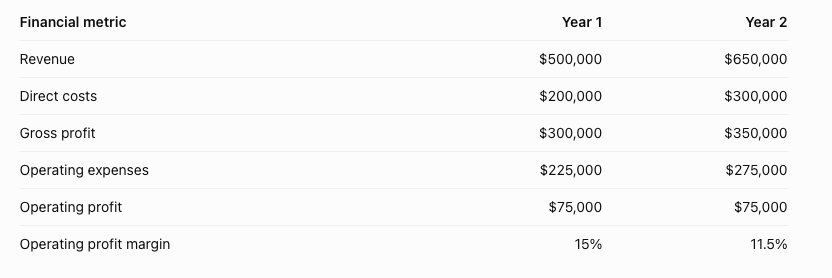
Revenue increased by 30%, but operating profit remained exactly the same.
The business is generating an additional $150,000 in annual revenue without improving its operating profit. Its profit margin has also declined, meaning it earns less operating profit for every dollar of revenue it generates.
There may be legitimate reasons for this. The business could be investing in infrastructure or building a team to support future growth.
However, understanding whether declining margins are intentional or the result of underlying financial problems is important.
1. Your Labor Costs Are Increasing Faster Than Revenue
As your business grows, you may need additional employees or contractors to support your customers.
The challenge is determining whether the additional revenue you're generating is enough to justify those costs.
When evaluating labor expenses, consider more than employee salaries. Payroll taxes, benefits, training, software licenses, and management time can all contribute to the overall cost of expanding your team.
It's also worth looking at how effectively your existing team is being utilized.
For a service-based business, that might involve reviewing how much time employees spend delivering client services compared with administrative work, internal meetings, or correcting mistakes.
Before assuming that growth requires another employee, take some time to understand whether your existing processes could be improved.
We've discussed several of these considerations in our article on how to know if your business can afford to hire.
2. Your Pricing Hasn't Kept Up With Your Costs
When was the last time you evaluated what it actually costs your business to deliver its products or services?
You may have established your pricing several years ago when your expenses, team structure, and service offerings looked considerably different.
Since then, your software subscriptions may have become more expensive. Employee compensation may have increased. Your customers may also be receiving more support than they were when you originally established your pricing.
Consider a hypothetical service that generates $2,000 in monthly revenue.
When you originally established the price, it cost your business $1,000 to deliver that service. Your gross profit margin was 50%.
If your delivery costs have since increased to $1,400 while your pricing remains unchanged, your gross profit margin has declined to 30%.
Bringing on more customers at that price increases your revenue, but each customer contributes less toward covering overhead and generating profit than they did previously.
Reviewing your pricing should involve understanding your current delivery costs, the value you're providing, and the profit margins your business needs to maintain.
3. You're Growing the Less Profitable Parts of Your Business
Not every dollar of revenue contributes equally to profitability.
Some products or services may require considerably more employee time, materials, or customer support than others.
For example, a business might offer two services that each generate $100,000 in annual revenue.
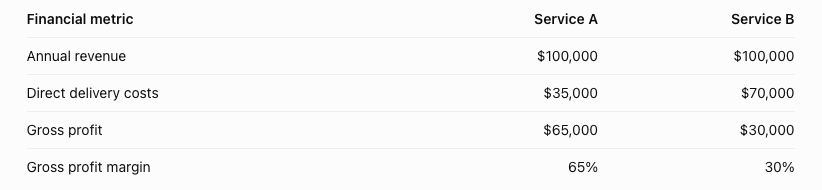
Both services generate the same revenue, but Service A contributes more than twice as much gross profit toward covering the business's overhead and generating operating profit.
If most of your new customers are purchasing Service B, your overall revenue could increase while your business's gross profit margin declines.
This is why looking at profitability across your individual services, products, or customer segments can be so valuable.
Your financial statements may tell you whether your business as a whole is profitable. A more detailed analysis can help you understand which parts of your business are contributing most to that profitability.
That information can also influence where you focus your marketing efforts, allocate employee resources, and invest in future growth.
4. Your Operating Expenses Are Growing Unnecessarily
As businesses grow, expenses often accumulate gradually.
You subscribe to another software platform, increase your marketing budget, expand your office space, or bring on additional administrative support.
Individually, each decision may make sense. Over time, however, those expenses can create a significantly higher cost of operating your business.
One advantage of growing a business is that certain expenses don't necessarily need to increase at the same rate as revenue.
Your existing accounting software, for example, may be able to support a higher volume of business without requiring a more expensive subscription.
The same may be true of some administrative functions and other operating expenses.
Reviewing your expenses periodically can help you distinguish between costs that genuinely support your business and costs that have simply accumulated over time.
This doesn't mean you should eliminate every expense that doesn't directly generate revenue. Some investments improve efficiency, reduce risk, or support your team's ability to deliver quality work.
The goal is to understand what you're spending money on and whether those expenses continue to make sense for your business.
5. You're Providing More Than You're Charging For
This is particularly important for professional service businesses.
You may have established an agreement with a customer that covers a specific set of services. Over time, additional meetings, requests, reporting, and support become part of the relationship without a corresponding adjustment to your pricing.
You might not notice the financial impact immediately, especially if the customer continues to pay their invoices on time.
But the additional work still requires resources.
When this happens across multiple customer relationships, your team can become increasingly busy without generating additional revenue for the work they're performing.
Reviewing the actual cost of serving your customers can help you identify where service expectations have changed and whether your pricing still reflects the work involved.
Sometimes the solution is adjusting your fees. Other times, it's establishing clearer service boundaries or improving the way your team delivers those services.
6. You're Investing in Growth Before Seeing the Financial Return
There are circumstances where increasing revenue without increasing profit is perfectly reasonable.
You might be hiring employees ahead of anticipated demand, investing in new technology, developing a new service offering, or expanding into another market.
These decisions can temporarily reduce profitability while positioning your business for future growth.
What's important is having a financial plan for those investments.
Before committing to a significant expense, consider when you expect it to begin generating additional revenue or reducing costs. Determine how long your business can support the investment and what happens if the expected financial benefits take longer to materialize.
A financial forecast can help you evaluate these scenarios before committing to an expense.
It can also help you distinguish between a temporary decline in profitability that you've planned for and a longer-term financial issue that needs to be addressed.
How to Determine Why Your Profit Isn't Increasing
Start by comparing your financial performance over time rather than focusing exclusively on your most recent profit and loss statement.
Review your gross profit margin
Calculate your gross profit margin for comparable periods. A declining margin may indicate that the direct costs associated with generating revenue are increasing, or that your sales are shifting toward less profitable offerings.
Compare operating expenses as a percentage of revenue
Looking at expenses in dollar amounts is useful, but evaluating them relative to revenue can provide additional insight.
If your revenue increased by 15% while your administrative expenses increased by 30%, it's worth understanding what caused that difference.
Evaluate profitability by service or product
Identify which offerings contribute most to your gross profit and which require a disproportionate amount of your team's time or other resources.
This can help inform decisions about pricing, service offerings, and where you want your business to grow.
Update your financial projections
Once you understand what's affecting your profitability, incorporate that information into your financial forecast.
Consider how changes to pricing, staffing, expenses, or your mix of services could affect your financial performance over the next 12 months.
What Should You Prioritize: Revenue Growth or Profit Growth?
The answer depends on what you're trying to accomplish with your business.
There may be periods when you're comfortable accepting lower profit margins because you're investing in future growth. There may also be periods when improving profitability is more important than bringing on additional customers.
If your business is already generating substantial revenue but you're struggling to build cash reserves, compensate yourself appropriately, or support your existing financial commitments, increasing revenue may not be the most effective solution.
You might benefit more from improving the profitability of the business you already have.
It's worth considering what you actually want your business to provide for you. That might include greater financial stability, more flexibility, the ability to build a stronger team, or eventually stepping away from some of the day-to-day responsibilities.
Your financial goals should support those objectives.
Make Sure Your Growth Is Working for You
Growing a business requires considerable time, energy, and financial resources. Understanding what you're earning from that growth can help you determine whether you're moving in the direction you intended.
At T&O Strategic Advisory, Sarah and I help business owners understand what's driving their financial performance and evaluate opportunities to improve profitability.
If your business is generating more revenue but you're not seeing the financial improvement you expected, we'd be happy to start the conversation.
Frequently Asked Questions
Why is my revenue increasing but my profit decreasing?
Profit can decrease despite revenue growth when direct costs, operating expenses, or other expenses increase faster than revenue. Changes in pricing, labor costs, and the mix of products or services sold can also contribute to declining profitability.
Can a business grow revenue without increasing profit?
Yes. A business can generate more revenue without increasing profit when the additional costs associated with growth absorb the additional income. This can happen intentionally during periods of investment or unintentionally because of declining margins.
What is the difference between revenue growth and profit growth?
Revenue growth measures the increase in income generated through business activities. Profit growth measures the increase in earnings remaining after applicable expenses have been deducted.
How can I increase profit without increasing revenue?
Businesses may be able to improve profitability by adjusting pricing, reducing unnecessary expenses, improving operational efficiency, or shifting their sales toward higher-margin products and services. The appropriate approach depends on the underlying causes of their financial performance.
Why does my profit margin decrease as my business grows?
Profit margins may decline when a growing business experiences higher labor costs, increased overhead, inefficient processes, or changes in its sales mix. Reviewing direct costs and operating expenses relative to revenue can help identify the cause.
Can a fractional CFO help improve business profitability?
A fractional CFO can help business owners analyze profit margins, evaluate pricing and expenses, develop financial forecasts, and understand the potential financial impact of strategic decisions.