
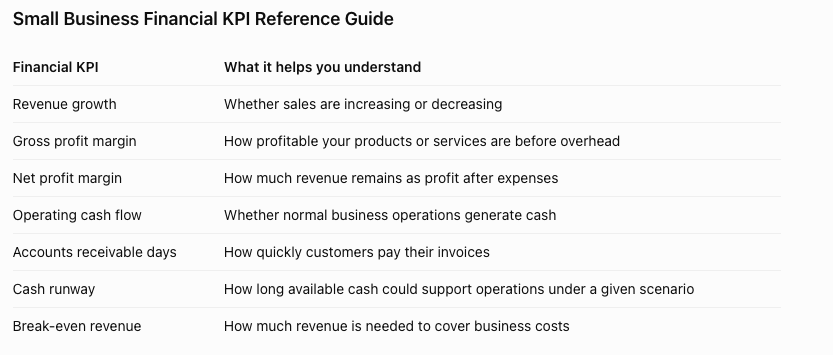
The seven financial KPIs small business owners should track are revenue growth, gross profit margin, net profit margin, operating cash flow, accounts receivable days, cash runway, and break-even revenue. Together, these metrics help business owners evaluate profitability, financial stability, operating efficiency, and their ability to support future growth.
You can look at your profit and loss statement every month and still have questions about how your business is actually doing.
Revenue might be increasing, but you're not seeing much of a difference in your bank account. Your expenses might be relatively consistent, but you're unsure whether you can afford another employee. You might even be having your most profitable year yet while feeling less financially comfortable than you did last year.
Understanding a few key financial metrics can help you figure out what's happening and where your attention is needed.
What Are Financial KPIs?
Financial key performance indicators (KPIs) are measurable indicators that help you evaluate the financial performance and health of your business.
While your financial statements provide detailed information about your business's financial activity, KPIs help you interpret that information and identify trends that deserve a closer look.
The financial KPIs you track should reflect your business model, financial goals, and the decisions you're trying to make.
Here are seven that are worth understanding.
1. Revenue Growth Rate
Revenue growth measures how much your business's revenue has increased or decreased over a specific period.
How to calculate revenue growth:
( Current period revenue − Previous period revenue ) ÷ Previous period revenue × 100
For example, if your business generated $200,000 last quarter and $220,000 this quarter, your quarterly revenue growth rate would be 10%.
But the percentage alone doesn't tell you why your revenue increased.
Did you bring on new customers? Increase your prices? Complete a particularly large project? Sell more to your existing customers?
Understanding what's driving that growth helps you determine whether it's something your business can reasonably expect to sustain.
It's also important to compare appropriate periods. If your business experiences seasonal fluctuations, comparing revenue with the same period last year may be more useful than comparing consecutive months.
Revenue growth should also be evaluated alongside profitability. Generating more revenue doesn't necessarily mean your business is making more money.
2. Gross Profit Margin
Gross profit margin measures how much revenue remains after covering the direct costs associated with delivering your products or services.
How to calculate gross profit margin:
( Revenue − Cost of goods sold ) ÷ Revenue × 100
For service-based businesses, direct costs may include employee labor or contractor expenses associated with delivering client services, depending on how the business classifies its costs.
If your business generates $100,000 in revenue and incurs $40,000 in direct costs, your gross profit margin is 60%.
That remaining $60,000 is available to cover your other operating expenses and contribute to profit.
Tracking your gross profit margin over time can help you identify problems with pricing, labor efficiency, supplier costs, or service delivery.
For example, if your revenue is increasing but your gross profit margin is declining, it may be worth reviewing whether you're charging enough to cover the actual cost of serving your customers.
You may also benefit from evaluating gross profit margins by service, product, or customer type. Some of your highest-revenue offerings may not be your most profitable.
3. Net Profit Margin
Net profit margin measures how much of your revenue remains as profit after accounting for your business's expenses.
How to calculate net profit margin:
Net income ÷ Revenue × 100
If your business generates $500,000 in annual revenue and reports $75,000 in net income, your net profit margin is 15%.
Unlike gross profit margin, net profit margin considers the broader cost of operating your business.
This includes expenses such as administrative payroll, rent, marketing, insurance, software, and interest, as applicable.
When evaluating your net profit margin, consider how it has changed as your business has grown.
Perhaps you've doubled your revenue over the past few years, but your net profit margin has gradually declined. That could indicate that your business has become more expensive to operate without generating a proportional increase in profit.
There isn't one ideal profit margin that applies to every business. Your industry, operating model, growth stage, and financial goals all influence what a sustainable margin looks like.
What's particularly useful is understanding your own trends and what's causing them.
4. Operating Cash Flow
Operating cash flow measures the net amount of cash generated or used by your business's normal operating activities.
It helps you understand whether your day-to-day business activities are generating enough cash to support ongoing operations.
How to calculate operating cash flow using the direct method:
Operating cash receipts − Operating cash payments
Operating cash flow can typically be found on your statement of cash flows, when one is prepared.
A business can report a profit while experiencing negative operating cash flow.
This can happen when customers haven't paid their invoices, inventory purchases require substantial upfront spending, or the timing of expenses doesn't align with incoming payments.
We've covered this distinction in more detail in our article about why profitable businesses can still struggle with cash flow.
If your business regularly needs additional financing or owner contributions to cover normal operating expenses, understanding your operating cash flow should be a priority.
5. Accounts Receivable Days
Accounts receivable days, also known as days sales outstanding (DSO), estimates how long it takes your business to collect payment from customers.
How to calculate accounts receivable days:
Average accounts receivable ÷ Net credit sales × Number of days in the period
If your customers are supposed to pay within 30 days but your accounts receivable days are consistently closer to 60, you may have a collection or payment-timing issue.
That additional month can make a considerable difference when you're responsible for covering payroll and other expenses.
Reviewing this metric can help you determine whether you need to adjust your payment terms, invoice customers sooner, require deposits, or improve your collection processes.
It's also worth reviewing your accounts receivable aging report alongside this metric. An average can sometimes hide a small number of significantly overdue invoices.
For businesses that collect payment upfront, accounts receivable days may be less relevant. The KPIs you choose should reflect how your business actually operates.
6. Cash Runway
Cash runway estimates how long your business can continue operating using its available cash under an assumed spending or cash-burn scenario.
For businesses spending more cash than they're generating, cash runway can provide an indication of how much time they have to improve their financial position.
How to calculate cash runway when experiencing negative cash flow:
Available cash ÷ Average monthly net cash burn
For example, a business with $90,000 in available cash and an average monthly net cash burn of $15,000 has an estimated cash runway of six months.
For businesses generating positive cash flow, it may be more useful to evaluate cash reserves against essential monthly operating expenses or model a temporary decline in revenue.
Consider what would happen if your largest customer left, a significant project was delayed, or an unexpected expense occurred.
Would your business have enough cash available to continue operating comfortably while you addressed the situation?
Understanding how much cash your business should keep in reserve can also help you evaluate whether you're financially prepared to take on additional commitments.
7. Break-Even Revenue
Break-even revenue represents the amount of revenue your business needs to generate to cover its fixed and variable costs, before generating a profit.
How to calculate break-even revenue:
Fixed costs ÷ Contribution margin ratio
Your contribution margin ratio is calculated by subtracting variable costs from revenue and dividing the result by revenue.
Suppose your business has $30,000 in monthly fixed expenses and a contribution margin ratio of 60%.
Your monthly break-even revenue would be $50,000.
Knowing your break-even point can be particularly helpful when you're considering changes to your business.
For example, when you're evaluating whether your business can afford to hire another employee, understanding how that additional expense affects your break-even point can help you determine how much revenue you'll need to support the decision.
The same applies when you're considering moving into a larger office, investing in technology, or making other long-term financial commitments.
Your break-even point should be recalculated as your cost structure changes.
How Often Should You Review Your Financial KPIs?
For many established small businesses, reviewing financial KPIs monthly is a reasonable starting point.
Once your monthly accounting is complete, compare your financial performance with previous periods, your budget, and your financial forecast.
Some metrics may need more frequent attention. If you're experiencing cash flow challenges, for example, reviewing your cash position and outstanding invoices weekly may be more appropriate.
What matters is that you're reviewing your numbers frequently enough to make adjustments before a financial issue becomes more difficult to address.
How to Choose the Right Financial KPIs for Your Business
You don't necessarily need to track dozens of financial metrics.
Start by thinking about the decisions you're currently trying to make.
If you're focused on improving profitability, gross profit margin and net profit margin may deserve more attention.
If you're concerned about meeting financial obligations, operating cash flow, accounts receivable days, and cash reserves may be more relevant.
If you're preparing to expand, understanding your break-even point and projected financial performance can help you evaluate what your business can realistically support.
Your priorities will change as your business evolves, and the financial metrics you monitor should reflect those changes.
Turn Your Financial Information Into Better Business Decisions
Having accurate financial information is important, but there's also value in understanding what that information means for your business.
Knowing that your profit margin declined last quarter is useful. Understanding why it declined, whether it's likely to continue, and what you can do about it is where financial advisory becomes particularly valuable.
At T&O Strategic Advisory, Anna and I work with business owners to help them understand their financial performance and evaluate the decisions they're making about the future of their businesses.
If you're reviewing your financial results and aren't sure which numbers deserve more attention, we'd be happy to start the conversation.
Frequently Asked Questions
What are the most important financial KPIs for a small business?
Revenue growth, gross profit margin, net profit margin, and operating cash flow are useful starting points for many small businesses. Additional metrics, such as accounts receivable days, cash runway, and break-even revenue, can help evaluate specific financial challenges and decisions.
What is the difference between a financial metric and a KPI?
A financial metric measures a specific aspect of financial activity or performance. A KPI is a metric selected because it helps evaluate progress toward an important business objective.
What is a good net profit margin for a small business?
There is no universal net profit margin target for small businesses. Appropriate margins vary depending on industry, operating expenses, business model, and growth stage. Comparing historical performance and relevant industry benchmarks can help establish meaningful targets.
Can a profitable business have poor financial KPIs?
Yes. A profitable business may still experience slow customer payments, insufficient cash reserves, declining gross profit margins, or negative operating cash flow. Reviewing multiple financial KPIs provides a more complete understanding of financial health.
How can a fractional CFO help with financial KPIs?
A fractional CFO can help identify relevant financial KPIs, establish meaningful performance targets, interpret financial trends, and evaluate how business decisions could affect future profitability and cash flow.
Do small businesses need a financial KPI dashboard?
A financial KPI dashboard can make it easier to monitor performance and identify changes over time. However, a straightforward monthly financial report may be sufficient for businesses with less complex operations.