
To create a financial forecast for your small business, start with historical financial data, project future revenue, estimate operating expenses, and evaluate your expected cash flow. Update your forecast regularly using actual financial results, changes in your business, and market conditions to make more informed financial decisions.
When business owners sit down to plan for the upcoming year, it's common to start with a revenue goal. Maybe you want to increase sales by 10%, bring on more clients, or expand into a new market.
But where are those numbers coming from?
You can put a percentage into a spreadsheet and calculate what your revenue would look like over the next 12 months. Unless you've considered how your business will achieve that growth and what it will cost, though, those numbers aren't going to be particularly useful when it's time to make financial decisions.
What Is a Financial Forecast?
A financial forecast is a projection of your business's future financial performance based on historical results, current financial information, and reasonable assumptions about what you expect to happen.
A small business financial forecast typically includes:
Projected revenue
Direct costs
Operating expenses
Expected profitability
Cash inflows and outflows
Anticipated financing and investments
The purpose of forecasting is to give yourself enough financial visibility to make decisions before they become urgent.
When you're considering hiring an employee, increasing your prices, investing in equipment, or taking on a larger client, your forecast can help you understand how those decisions could affect the rest of your business.
What's the Difference Between a Budget and a Financial Forecast?
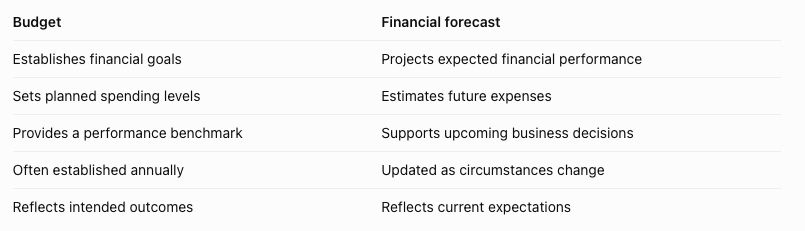
A budget establishes what you plan to earn and spend over a specific period. A financial forecast estimates what you're actually likely to earn and spend based on the information available today.
Both serve an important purpose.
Your budget gives you something to measure your performance against. Your forecast helps you understand where you're headed and whether you need to make adjustments.
You might establish an annual revenue goal in January, for example, but discover by April that you're acquiring new customers more slowly than anticipated. Your forecast should reflect that change, even if your original budget remains the same.
1. Start With Your Historical Financial Data
Before projecting what your business might do next year, spend some time understanding what it has already done.
Review your financial statements from the previous 12 months or longer, if available. Pay particular attention to:
Monthly revenue trends
Gross profit margins
Recurring operating expenses
Seasonal fluctuations
Customer acquisition and retention
Changes in labor costs
Unusual or nonrecurring transactions
Looking at your annual revenue alone can hide some important details about how your business operates.
You may have experienced a particularly strong quarter because of one large project. You may have incurred expenses that won't repeat next year. You might also discover that certain months are consistently slower than others.
All of these details should inform your projections.
This is also why having accurate, up-to-date accounting records matters. If your historical financial information is incomplete or inaccurate, it becomes much more difficult to build a reliable forecast.
2. Build Revenue Projections Around Real Business Activity
One of the biggest mistakes you can make when forecasting revenue is assigning an arbitrary growth percentage without considering what will drive that growth.
The way you project revenue will depend on the type of business you operate.
Service-based businesses
If you operate a service-based business, you may already have a relatively clear picture of some of your future revenue.
Start by reviewing your existing clients, current pricing, recurring agreements, and upcoming projects.
From there, consider how many new clients you realistically expect to acquire, when they might start working with you, and whether you have the capacity to serve them.
Your forecast should also account for potential client departures and changes in the services existing clients purchase.
Product-based businesses
For product-based businesses, revenue forecasting may involve additional variables, including sales volume, inventory availability, product pricing, and seasonal purchasing patterns.
Review historical sales trends to understand when demand typically increases or decreases. Consider whether upcoming marketing campaigns, new products, or changes in pricing could affect those patterns.
You also need to consider the cost of producing or purchasing the additional products you expect to sell.
Increasing sales doesn't necessarily improve profitability if the costs associated with generating those sales increase at the same rate.
3. Estimate Your Expenses Independently of Revenue
It's easy to assume that as revenue increases, expenses will increase proportionately. But that isn't necessarily how your business needs to operate.
Take a software subscription, for example.
If your existing software can accommodate additional clients without requiring an upgrade, you may be able to increase revenue without increasing that particular expense. As a result, your profit margins could improve.
On the other hand, acquiring additional clients might require more employees, additional software licenses, or outside support.
When forecasting expenses, separate your costs into three categories.
Fixed expenses: Costs that generally remain consistent, such as rent, insurance, and certain software subscriptions.
Variable expenses: Costs that fluctuate with business activity, such as inventory, materials, transaction fees, and certain labor expenses.
Planned expenses: Upcoming investments or commitments, such as hiring, equipment purchases, technology upgrades, or expansion.
It's also important to consider potential price increases from your vendors. Just because a subscription or service has cost the same amount for several years doesn't mean it will continue to do so.
Understanding which expenses actually need to increase as your business grows can help you make better decisions about profitability.
4. Include Cash Flow in Your Financial Forecast
Projected profitability is important, but it doesn't tell you everything about your business's ability to meet its financial obligations.
You also need to understand when money will actually enter and leave your business.
For example, you might complete a project and invoice a customer in January but not receive payment until March. In the meantime, you still need to cover payroll, software, rent, and other operating expenses.
Your financial forecast should account for the timing of customer payments, vendor payments, loan repayments, estimated tax payments, and other cash commitments.
A cash flow forecast can help you identify periods when your available cash may be particularly tight, even if your business is expected to be profitable.
We've discussed this distinction in more detail in our previous article about why a profitable business can still struggle with cash flow.
You should also consider how much cash your business needs to keep in reserve before committing to additional expenses or investments.
5. Consider Factors Outside Your Business
You have some control over your pricing, spending, hiring decisions, and marketing activities. You have considerably less control over the broader economic conditions affecting your business.
Changes in supplier pricing, interest rates, labor costs, consumer demand, and supply chains can all affect your financial performance.
Even a small service-based business can feel the effects of these changes.
For example, an increase in the cost of essential practice management software may be unavoidable. Your options might include absorbing the additional expense, adjusting your pricing, or finding efficiencies elsewhere in the business.
You don't need to predict every economic development. You do need to consider which external factors could materially affect your business and adjust your financial expectations when those factors change.
6. Create a Rolling 12-Month Financial Forecast
One approach I particularly like is a rolling financial forecast.
Rather than creating a forecast in January that ends in December, a rolling forecast continually looks ahead over the next 12 months.
As each month ends, you incorporate your actual financial results, revise your assumptions, and add another month to the end of your forecast.
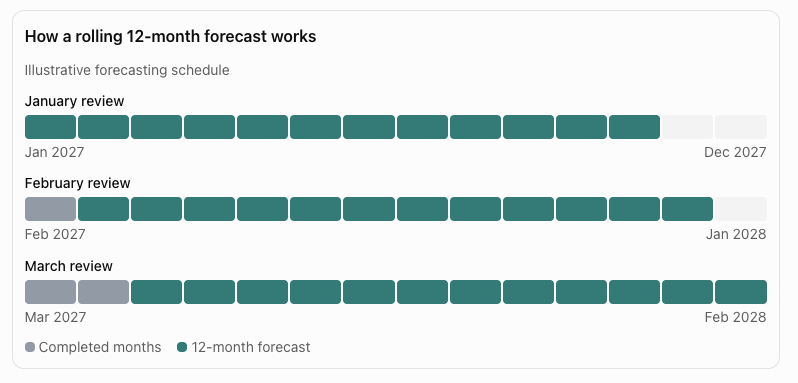
Let's say you start the year without plans to hire another employee. A month later, you acquire a large client and decide you need additional support.
Your revenue expectations have changed, but so have your labor costs.
A rolling forecast allows you to incorporate both changes and evaluate what they mean for your business over the next 12 months.
The same approach applies when you lose a client, experience an unexpected expense, or discover that your sales are performing differently than anticipated.
You're working with the information you have today rather than continuing to rely on assumptions you made several months ago.
7. Compare Your Forecast With Actual Financial Results
Creating a forecast is only useful if you continue to refer to it.
Ideally, reviewing your financial forecast should be part of your monthly accounting cycle. Once your monthly financial statements are complete, compare your actual results with your budget and forecast.
Consider the following questions:
Did revenue meet expectations?
Were expenses higher or lower than anticipated?
Have profit margins changed?
Are customers paying within the expected timeframe?
Have any assumptions about future business activity changed?
When you identify a significant difference, spend some time understanding why it occurred.
Lower-than-expected revenue could be the result of delayed projects, fewer new customers, or changes in demand. Higher expenses might reflect an unexpected cost or a necessary investment that will benefit the business later.
Understanding the reason behind the difference is what allows you to make a more informed decision about what happens next.
Discovering in June that you're falling short of your annual revenue goal gives you six months to consider your options. Discovering the same thing in December leaves considerably less room to make adjustments.
When Should You Get Help With Financial Forecasting?
A basic spreadsheet may be sufficient when you're first starting a business and have relatively straightforward revenue and expenses.
As your business grows, forecasting can become more complicated. You might be managing multiple revenue streams, additional employees, larger financial commitments, or increasingly unpredictable cash flow.
Working with a financial advisor or fractional CFO can be particularly helpful when you're:
Planning to expand your business
Evaluating whether you can afford to hire
Experiencing inconsistent cash flow
Preparing for a significant investment
Trying to improve profit margins
Making decisions about financing or debt
Having someone help you evaluate the assumptions behind your forecast can be just as valuable as having someone prepare the numbers.
At T&O Strategic Advisory, Sarah and I help business owners better understand their financial performance and evaluate the decisions that will affect their businesses moving forward.
If you're preparing for the upcoming year and want a clearer picture of what your business can realistically support, we're always happy to start the conversation.
Frequently Asked Questions
How far ahead should a small business forecast?
A rolling 12-month forecast is a practical starting point for many small businesses. Businesses considering significant investments, financing, or expansion may also benefit from longer-term financial projections.
How often should a financial forecast be updated?
Ideally, a financial forecast should be reviewed and updated monthly as actual financial results become available. At a minimum, business owners should consider reviewing their projections quarterly and whenever a significant change occurs.
Can I create a financial forecast without historical financial data?
Yes. New businesses can develop forecasts using anticipated pricing, estimated sales volume, expected operating expenses, and available market research. These assumptions should be revisited regularly as actual financial information becomes available.
What is the difference between a revenue forecast and a financial forecast?
A revenue forecast estimates future sales or income. A financial forecast provides a broader picture by incorporating revenue, expenses, profitability, cash flow, and other financial commitments.
Do I need a fractional CFO to create a financial forecast?
Not necessarily. Business owners with straightforward finances may be able to create and maintain their own forecasts. A fractional CFO can provide additional support when financial decisions become more complex or require more detailed analysis.